



BISHOP'S OFFICE
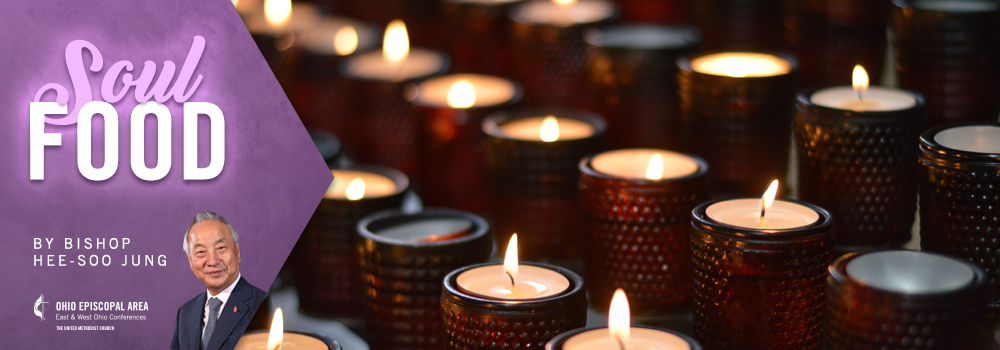
All Saints Sunday has become one of the most meaningful days in the Christian calendar for me.
I grew up in a Korean family shaped by Confucian traditions of honoring our ancestors. At certain times of the year, the family gathered, food was prepared with care and those who had gone before us were remembered. We remembered names, stories, sacrifices and the roots from which our family had grown.
When I became a Christian when I was 16 years old, I was taught that following Jesus meant refusing to participate in those ancestral rites. I did so with conviction. At the time, I believed that such refusal was a necessary expression of Christian faithfulness. It also created pain and tension within my family.
Years later, All Saints Sunday brought an unexpected theological healing to that memory.
I watched the church light candles and speak the names of those who had died. We remembered parents and grandparents, pastors and teachers, friends and faithful members of the church. We gave thanks for their lives and entrusted them to the mercy of God. Something within me was restored.
The church, I realized, also knows how to remember.
Christian faith does not require us to cut ourselves off from those who came before us. Rather, it teaches us how to remember them within the grace of God.
Scripture itself is filled with sacred memory. Abraham carefully secured a burial place for Sarah. Jacob asked to be buried with his ancestors. Joseph asked that his bones be carried toward the promised land. Israel was repeatedly commanded to remember God’s saving acts and to tell the story to the next generation.
Biblical faith is a remembering faith.
All Saints Sunday therefore belongs to the deep Christian confession of the communion of saints. The church is larger than those of us who are alive at this moment. In Christ, we belong to a communion that stretches across generations.
To remember the saints is not to claim that they were perfect. Saints are not flawless people. They are people whose lives bear witness, however imperfectly, to the work of grace.
And so, All Saints Sunday begins with gratitude.
None of us is self-made. We are here because others prayed for us, taught us, forgave us, sacrificed for us, opened doors for us and sometimes carried burdens we never knew they carried. But Christian remembrance is more than nostalgia. When we remember those who came before us, a question quietly turns toward us:
What kind of ancestors are we becoming?
One day, we too will become part of someone else’s memory. What will we leave behind? Will we leave resentment or reconciliation? Fear or courage? Scarcity or generosity? Wounds or wisdom? Walls or pathways?
This is where All Saints Sunday becomes a call to sanctification.
Holiness is not merely personal moral achievement. It is the work of grace by which our lives become a blessing to others and an inheritance for those who follow us. This is especially important in a time marked by so much trauma.
Families carry wounds. Churches carry conflicts. Communities carry histories of exclusion, violence, division and loss. We know that forgetting does not heal these wounds. Yet memory without grace can also imprison us.
Christian remembrance offers another way. We remember truthfully, but we remember within the mercy of God. We give thanks for what was good. We grieve what was broken. We name what must not be repeated. We seek forgiveness, reconciliation, and repair.
In this way, memory itself can become part of healing. For me, this is where the ancestral traditions of my childhood and All Saints Sunday have finally found a place of reconciliation.
Remembering is not the same as worshiping. Honoring those who came before us need not compete with our worship of God. In Christ, memory can be redeemed. The past can become gratitude rather than bondage, wisdom rather than nostalgia, and responsibility rather than regret.
Perhaps this is one of the deepest gifts of All Saints Sunday.
We remember those who came before us. We entrust them to God. We receive their blessings and their unfinished work. And then we turn toward those who will come after us.
May we leave them fewer wounds to carry. May we leave them deeper faith, wider mercy and more courageous love.
One day our names, too, may be spoken on an All Saints Sunday. When that day comes, perhaps the greatest blessing would be for someone to say:
They received the grace of God,
and they did not keep it for themselves.
They passed it on.

Bishop Hee-Soo Jung
Resident Bishop
Melissa McGee
Executive Secretary to the Bishop
Ext. 112
Rev. Ed Peterson
Executive Assistant to the Bishop
Ext. 111
The East Ohio Conference Office:
located in North Canton, OH,
near Akron-Canton Airport.
Address:
8800 Cleveland Ave. NW
North Canton, OH 44720
Phone:
(330) 499-3972
Office Hours:
Monday through Friday
8:30 a.m. - 4:00 p.m.