


BISHOP'S OFFICE
I find myself wondering what kind of face the new age will have.
For too long, we have understood strength as the power to dominate. We have celebrated expansion, possession, speed, and control. Too often, we have treated people, land, water, forests, and even God’s creation as resources for our own purposes.
But the earth is tired.
And people are tired.
In a world marked by war, division, ecological crisis, loneliness, and widening inequality, I find myself asking:
Is there another kind of power that can save life?
At that question, I hear again the words of Jesus:
“I came that they may have life, and have it abundantly.” – John 10:10 (NRSVA)
Jesus names the purpose of his coming with remarkable simplicity:
Life.
He did not come to dominate, but to give life.
Not to divide, but to gather.
Not to crush the vulnerable, but to raise them up.
Not to possess the world, but to reconcile it to God.
This is why I find myself thinking again about the spiritual meaning of the feminine.
By “the feminine,” I do not mean a quality that belongs only to women, nor do I wish to confine women to traditional images of nurture or motherhood. I mean something deeper: a spiritual capacity that all humanity, and perhaps especially the Church, desperately needs to recover.
The capacity to receive.
To nurture.
To wait.
To connect.
To hold what is wounded without discarding it.
To discover life where others see only endings.
The earth itself knows this wisdom.
The earth receives the seed.
Through winter, when nothing seems to be happening, it does not abandon life.
Grass rises again from wounded ground.
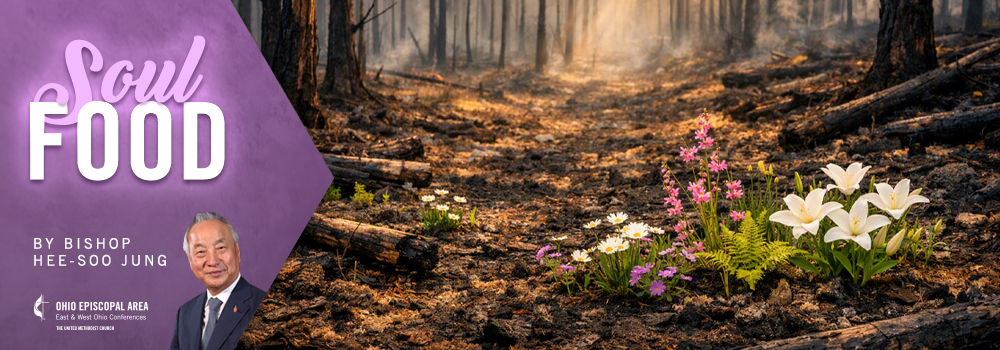
New shoots appear even in a burned forest.
I want to call this an earth-like feminine wisdom.
And yet, for Christian faith, this wisdom ultimately leads us to Christ.
Jesus embodied a power that gave life. He touched bodies others avoided. He welcomed those pushed to the margins. He fed the hungry. He sat at table with those judged unworthy. His authority did not diminish human beings; it restored them.
Even at the cross, the world attempted to prove its power through death.
God answered with resurrection.
The cross and resurrection therefore teach us a radically different grammar of power:
Love that gives life is stronger than power that destroys it.
I hear this same challenge in the voices of several contemporary women theologians.
Sarah Coakley invites us to reconsider Christian power as “power in vulnerability." Vulnerability before God need not mean passivity or weakness. In contemplative openness, surrender, and self-emptying, another kind of power may emerge – a power that does not coerce, yet transforms.
Chung Hyun Kyung calls theology back to the bodies and memories of those who have suffered. She once described Asian women’s theology as being “very Third World, very Asian, and very women.” Her theology refuses to begin only with abstract doctrine. It begins with lived pain, memory, bodies, and the struggle for liberation.
I have long remembered her image of the priests of han.
Han is not merely anger or sorrow. It carries the accumulated wounds of history – the pain of those silenced, violated, displaced, or forgotten. Yet those who carry han are not simply victims. They have often continued to cook, raise children, care for neighbors, sing, dance, pray, and rebuild community.
Perhaps they are also priests of life.
They are people who carry wounds without allowing the wound to have the final word.
And today I wonder whether the earth itself carries a kind of planetary han.
We hear it in polluted rivers and seas, disappearing forests, vanishing species, lands shattered by war, and in the cries of people forced from their homes by ecological disruption.
The earth groans.
Catherine Keller helps us name another dimension of this reality through the language of planetary entanglement. Human beings do not exist apart from nature. Our bodies, rivers, atmosphere, forests, neighbors, and future generations belong to a profound network of relationship. Our existence is marked by a fragile planetary interdependence.
One river dies, and human life becomes poorer.
One species disappears, and creation becomes smaller.
One community is abandoned, and the humanity of us all is diminished.
These three theological voices are different, yet together they point toward a common invitation:
Rethink power.
Listen to wounds.
Rediscover relationship.
And at the center of all three questions, I return, again, to Christ.
“I came that they may have life, and have it abundantly.”
Coakley’s “power in vulnerability” finds its deepest Christian expression in the cross.
Chung’s theology of han brings us close to the Christ who takes wounded humanity into his own body.
Keller’s vision of interdependence invites us to remember the cosmic Christ in whom, as Colossians declares, all things hold together.
Therefore, the goal is not to make femininity into a new ideology.
The goal is to rediscover the way of life revealed in Jesus Christ.
The power to embrace.
The power to connect.
The power to transform wounds into communion.
The power to nurture life where death appears to have won.
Jesus Christ did not come merely to explain life.
He came to give life.
This also reshapes our understanding of salvation.
If salvation is only about where I go after death, it is too small.
The salvation of Christ also asks:
What is being brought back to life?
Are wounded people being restored?
Are broken relationships being reconciled?
Are abandoned communities recovering hope?
Can exploited soil breathe again?
Can rivers live?
Can people who have forgotten their dignity rediscover that they are beloved children of God?
This is what I mean by a theology that gives life.
A theology that gives life to people.
To communities.
To wounded memories.
To land, water, forests, and the whole community of creation.
And Christ must remain at its center.
If the Church is the body of Christ, then wherever the Church is present, there should be more life.
More people recovering dignity.
More lonely people finding community.
More wounded people encountering healing.
More creation being protected.
More enemies discovering the possibility of reconciliation.
Perhaps the most important questions about the Church are not how large we are, how influential we are, or how successful we appear.
Perhaps the question is simply:
Are we giving life?
The revolution of the new age may begin in places that appear gentle.
In the strength to nurture.
The courage to wait.
The wisdom to reconnect what has been torn apart.
The capacity to hold wounds until life rises again.
This is not weak power.
It is the power revealed at the cross and vindicated in the resurrection.
The world often seeks to subdue people through power.
Christ raises people through love.
The world often creates order through exclusion and fear.
Christ creates a new community by giving himself away.
And so, at the deepest place of this earth-like feminine wisdom, I see Christ:
Christ who receives life.
Christ who protects life.
Christ who embraces the wounded.
Christ who brings life out of death.
And I hear his words again:
“I came that they may have life, and have it abundantly.”
Perhaps the new age will not arrive when the strongest finally win.
Perhaps it will begin when more of us learn how to give life.
The future belongs not to the power that conquers,
but to the love that gives life.
This, I believe, is the wisdom the earth is trying to teach us.
It is the wisdom carried through the voices of women.
It is the gospel revealed in the crucified and risen Christ.
And it is the calling of the Church in a wounded world:
to reweave life.

Bishop Hee-Soo Jung
Resident Bishop
Melissa McGee
Executive Secretary to the Bishop
Ext. 112
Rev. Ed Peterson
Executive Assistant to the Bishop
Ext. 111
The East Ohio Conference Office:
located in North Canton, OH,
near Akron-Canton Airport.
Address:
8800 Cleveland Ave. NW
North Canton, OH 44720
Phone:
(330) 499-3972
Office Hours:
Monday through Friday
8:30 a.m. - 4:00 p.m.