



BISHOP'S OFFICE
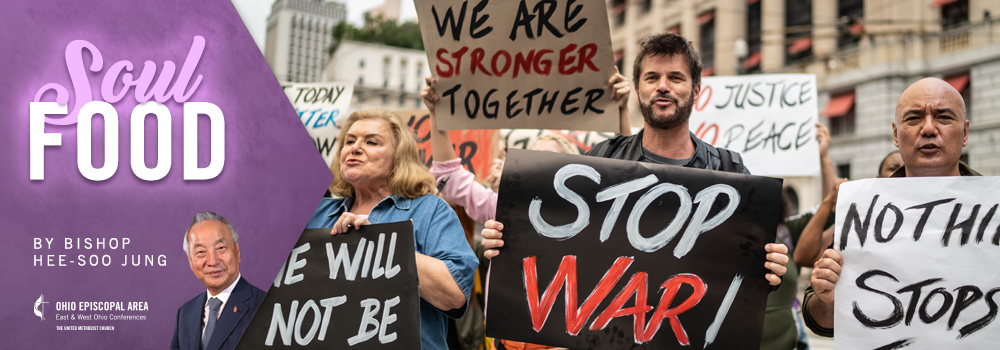
I was raised among the shadows of war.
In my childhood village, many of the older boys grew up without fathers. Some had gone to war and never returned. Others simply disappeared into history’s silence. Their absence shaped our lives. It was not just loss – it was a quiet, enduring grief that never found closure.
The Korean War, often described as ending in 1953, never truly ended. It paused. The armistice stopped the fighting, but it did not bring peace. Even today, millions of families remain separated, not knowing whether their loved ones are alive or dead.
War leaves behind more than ruins. It leaves unanswered questions that echo across generations.
I carry deep gratitude for the young Americans who sacrificed their lives during that Korean war. Their courage forged a bond between Korea and the United States that remains strong. But gratitude does not erase the moral weight of what war does to humanity.
Because I have seen its consequences, I cannot accept violence as a solution to human conflict.
Jesus once said to His disciple, “No more of this,” and took the sword from his hand. In that moment, He revealed a truth that still confronts us: violence cannot bring the peace we seek.
Today, war has become even more distant and more dangerous. Advanced technology allows destruction to be carried out remotely, almost like a simulation. But the suffering is not virtual. Children still die. Families are still shattered. Trauma still endures.
The conflicts we witness in the world today – especially war in the Middle East – should force us to ask difficult questions. What kind of future are we creating? Can security built on devastation truly be called peace?
I oppose terrorism. I oppose hatred. I oppose any form of violence that denies the dignity of human life. But I also believe this: indiscriminate destruction, even in the name of protection, cannot be justified.
War cannot be the final language of humanity.
We must choose a different path – one that is harder, slower, but ultimately more human: diplomacy, dialogue, restraint, and reconciliation. Peace is not weakness. It is courage.
As someone formed by the wounds of war, I cannot remain silent. I join with countless others in calling for an end to ongoing conflicts and for renewed commitment to peace – not only on the Korean Peninsula, but wherever violence persists.
My memories become prayer.
A prayer that wars may cease.
A prayer that violence may end.
A prayer that humanity may choose life over destruction.
It is not too late.
But the time is urgent. The time to choose peace is now.
May we stop the machinery of war before it consumes what remains of our shared future. May we dare to imagine peace – not as a distant hope, but as a present calling. And may we become, even now, those who write a new story, not of annihilation, but of reconciliation.
God of mercy,
where war still breathes,
let Your peace begin.
Where memories ache
and names are lost,
hold them in Your eternal light.
Where hands have learned violence,
teach them again
the work of healing.
Where enemies stand apart,
open a way
toward one another.
Christ, our peace,
who said, “No more,”
disarm our hearts.
Before it is too late,
turn us from destruction
to life.
Amen.

Bishop Hee-Soo Jung
Resident Bishop
Melissa McGee
Executive Secretary to the Bishop
Ext. 112
Rev. Ed Peterson
Executive Assistant to the Bishop
Ext. 111
The East Ohio Conference Office:
located in North Canton, OH,
near Akron-Canton Airport.
Address:
8800 Cleveland Ave. NW
North Canton, OH 44720
Phone:
(330) 499-3972
Office Hours:
Monday through Friday
8:30 a.m. - 4:00 p.m.